


Our 2026 Conference Roundup and Learnings


This spring, the Roots & Rivers team had the privilege of showing up to four gatherings across the country, in British Columbia, Ontario, Manitoba, and Alberta. Each brought together a different slice of the social purpose sector: nonprofit leaders, funders, social finance practitioners, workforce developers, and community organizers. Despite different interest-holders present across different conferences, the questions underneath were remarkably consistent.
Across four different gatherings, a few threads stayed with us.
Trust is the throughline.
Who gets trusted, on what basis, and who decides? The sector is constantly asked to prove itself, while the proxies used to extend trust, wealth, credentials, institutional credibility, often have little to do with what actually drives impact: relationships, community knowledge, and long track records of showing up.
The pressure is unevenly distributed.
Funding is shrinking, proof burdens are growing, and the communities most reliant on the sector are absorbing the consequences most acutely.
Collaboration is being asked to do too much.
When efficiency and collaboration are promoted as values by funders as a way to disburse fewer dollars or flatten the specificity of community-rooted work, they become something else. The sector needs to be clear-eyed about when calls for collaboration serve the community and when they serve the funder.
People are building alternatives, not just advocating for reforms.
From new financing tools, to collective power-building for sector workers, to employers committing to evaluate people beyond credentials, there is energy around constructing different systems rather than waiting for existing ones to change.
Read on for our conference learnings from each of the gatherings we attended this spring.
1. BC Nonprofit Leadership Conference (BCNPLC)
How do you imagine a collective future for the non-profit sector? At the two-day hybrid BC Non-Profit Leadership Conference 2026, sector leaders came together to envision a collective future for the non-profit sector.
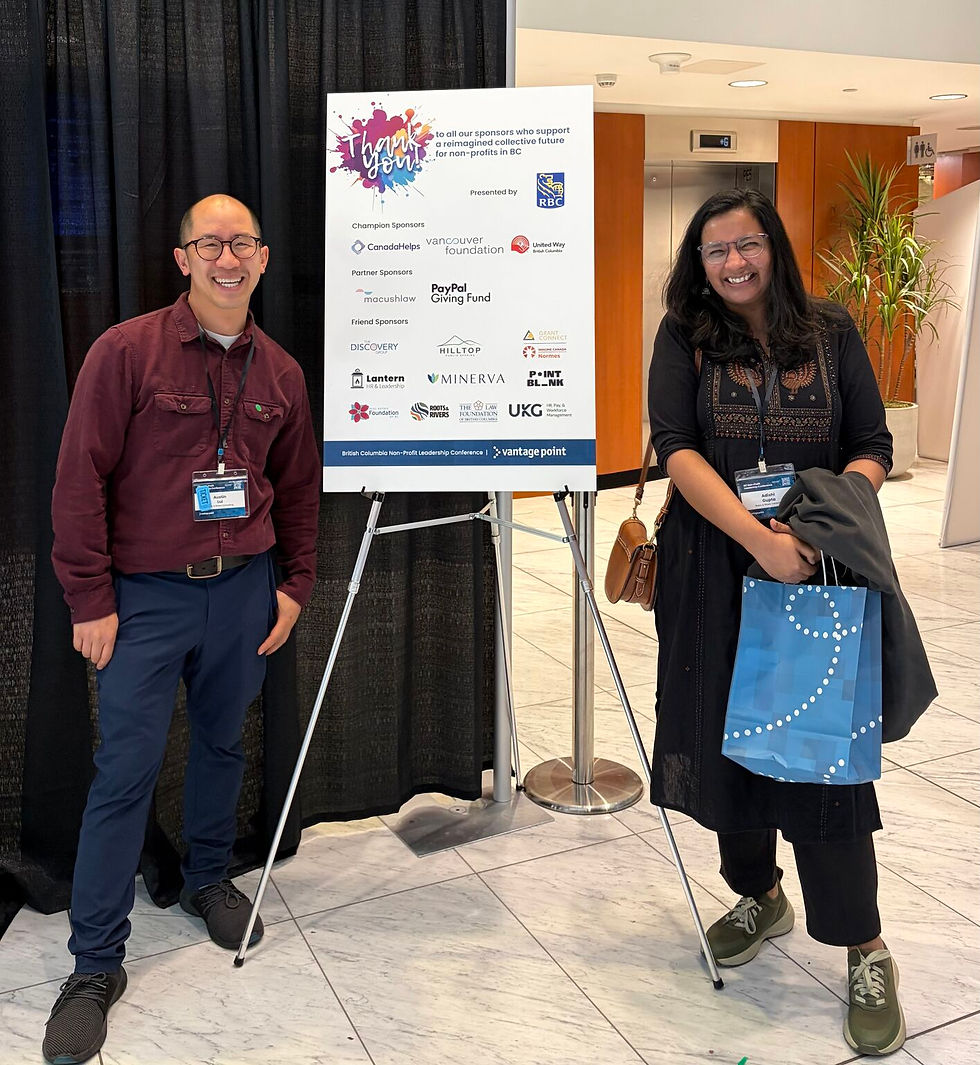
Hosted by Vantage Point, the conference brought together non-profit leaders, funders, and community partners from across BC and Canada, opening with a virtual day on June 4 and culminating in an in-person gathering at the Anvil Centre in New Westminster, on the unceded territory of the Qayqayt Nation. This year, Roots & Rivers was proud to participate as a presenter and a friend sponsor for the conference.
Day 1: Sector's Workforce
The virtual day set a clear tone: the challenges facing the non-profit sector are urgent, interconnected, and require collective response. Armine Yalnizyan grounded the day in economic context, naming the non-profit sector as essential infrastructure for Canada's future. From there, conversations wove through funding cuts impacting 2SLGBTQIA+ communities, the impossible trade-offs organisations face between competitive wages and service delivery, and the data behind shifting online giving trends.
Sessions on rural and remote non-profit work, climate resilience strategies rooted in DTES frontline experience, and the future of the non-profit workforce reminded us that there is no single story of this sector. It is vast, adaptive, and deeply human.
Team member Austin Lui joined Brianne De Man to share learnings from their collaborative work sunsetting EMBERS Eastside Works, a session that modelled the kind of honest, courageous sector storytelling the day called for.
Day 2: Values, Relationships, and What We Hold On To
The in-person day opened with a traditional Qayqayt welcome from Stacey Ferguson and built in depth what Day 1 established in breadth. Nerissa Allen's keynote on governing technology with courage and care offered a line worth sitting with:
Efficiency is not a substitute for responsibility.
Breakout sessions explored digital giving tools and shifting donor demographics, government relations strategies that move beyond transactional funding asks, and the legal landscape for non-profits. The afternoon brought one of the conference's most grounding conversations: a session on Truth, Reconciliation, and the Future that challenged organisations to move from performative gestures toward sustained, humble relationship-building with Indigenous communities.
Vantage Point closed the day with an interactive plenary on what meaningful collaboration can look like, and closing reflections from Zahra Esmail crystallised what had threaded through Day 2: while Day 1 asked what the sector needs to survive, Day 2 asked what values we refuse to leave behind.
We left with full minds and grateful hearts. Thank you to the Vantage Point team for creating a gathering that held complexity without losing hope. The sector's collective future is not yet written, and that feels less like uncertainty and more like possibility.
2. Fairer Funding Summit - Waterloo Region
Robyn E. Schwarz and Alicia Langill of Dumbo Octopus Consulting, alongside other local leaders, convened the Fairer Funding Summit: Waterloo Region in Cambridge, ON. Drawing together grassroots organizations and nonprofit support workers, the day created space for open conversation about the state of funding in the sector and what fairer alternatives could look like.

Several threads from the day are worth naming. Esther Saehyun L.'s keynote examined the nature of trust in funder-grantee relationships, and in particular, how trust is extended based on proxies like wealth and institutional credibility rather than what demonstrably matters: long-term relationships and community knowledge. Jesse Clarke's breakout session turned attention to collective power-building for nonprofit and charitable workers, a conversation that felt both timely and urgent.
Participant reflections also surfaced an observation:
When funders promote collaboration and efficiency as values, they can inadvertently, or not so inadvertently, use those values to disburse fewer funds while erasing the specificity that makes community-rooted work effective.
The summit was a strong signal that local momentum on fairer funding is building. With the Fair Funding Coalition's Connections Committee, Tamarack Institute's open letter to corporate and philanthropic funders, and gatherings like this one, the question now is how these threads connect into something with staying power.
3. Catalyst Community Finance Summit, Winnipeg
The Catalyst Community Finance Summit, organized by Geraldine Cahill and Jo Reynolds, brought together practitioners, funders, and social finance actors in Winnipeg for several days of learning and connection. For those newer to community and impact finance, the event was notable for how deliberately it brought people into the conversation, making complex financing mechanisms feel accessible without oversimplifying them.
Day 1: A central theme was financing gaps and the moments where different actors can intervene. Concrete examples illustrated the terrain: a nonprofit running a viable project but without collateral for a construction loan; an entrepreneur two product runs short of viability with existing grant funding. The presence of Purpose Construction, a social enterprise residential contractor providing skilled trades training and long-term employment to people facing barriers, grounded these conversations in what bridging those gaps looks like in practice.
A second thread ran alongside the first:
How community definitions of risk and scale differ from those of traditional finance. Risk, in this framing, is not just about repayment. Scale is not just about speed, but about moving at the speed of trust.
These reframings matter because they shift who gets to participate in the economy and on what terms.
The day also surfaced thinking on employee ownership models as a succession pathway for small and medium-sized businesses, a conversation with relevance for the broader social purpose sector.
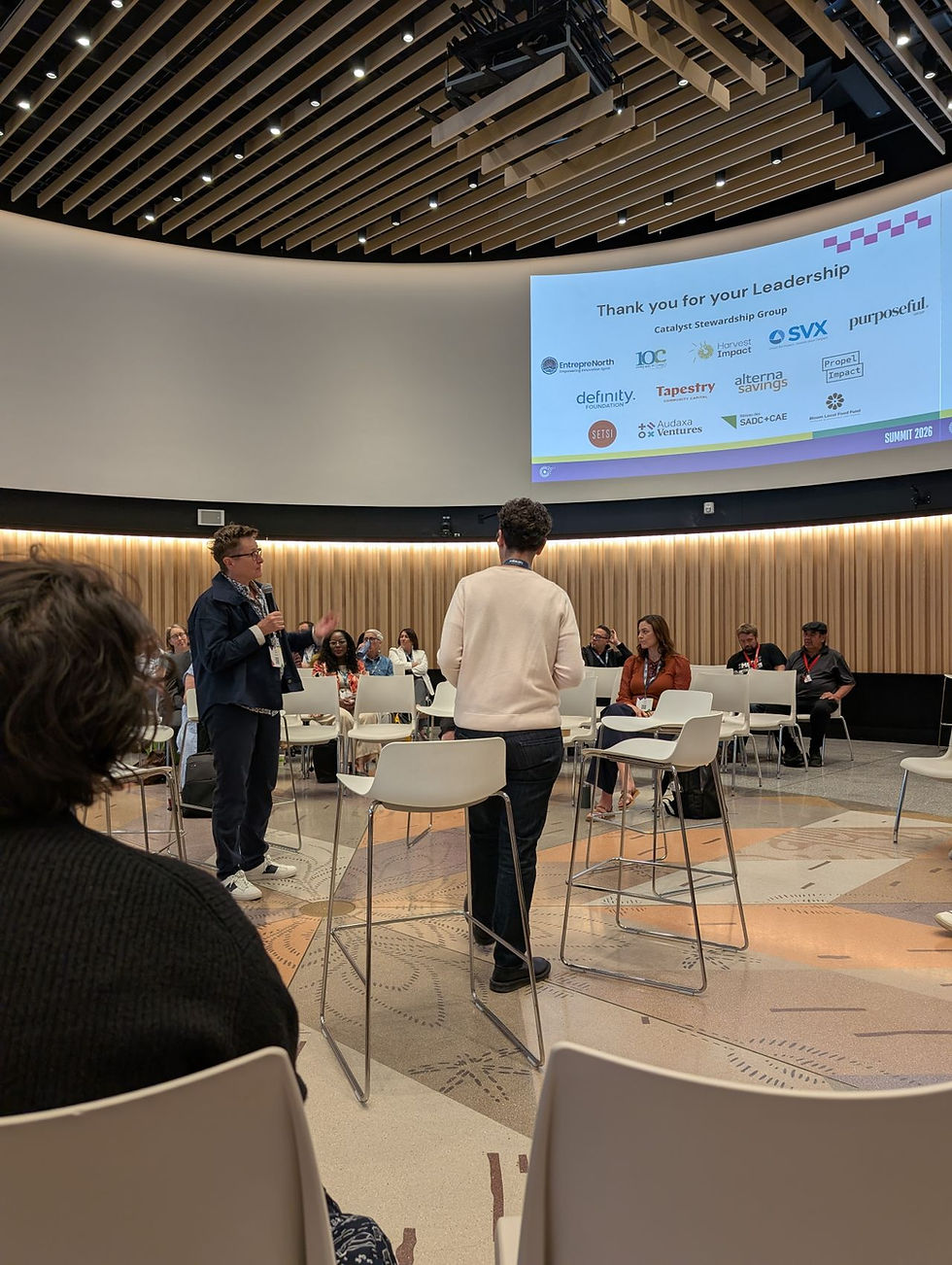
Day 2: The second day put a spotlight on work being done across the sector. Goparity Canada's crowd lending model, with a minimum investment of $20, and the Canadian Coalition for Community Capital's advocacy to enable Canadians to invest locally through TFSAs and RRSPs, both pointed toward a sector actively working to lower barriers to participation. Impact Guarantee, a pooled loan guarantee for Canada's social finance sector, added another layer to the picture of how the sector is building infrastructure for itself.
One of the Circles on Day 2 offered something less tangible but no less important: Wayne Miranda of Definity Foundation invited participants to consider the role of love in social and community finance. It was visible throughout, particularly in the relationships among long-time leaders in the space who have spent decades working to make catalytic things happen.
Day 3: The summit closed with a walking tour of Winnipeg led by Brian Rice, PhD, tracing First Nations, Métis, and settler histories from the legislature to The Forks. It was a fitting end to a gathering that took seriously the question of whose communities finance is meant to serve.
4. Canadian Forum on Social Innovation, Calgary
The Canadian Forum on Social Innovation, convened by Sandra Lapointe and The/La Collaborative team in Calgary, operates as a deliberate multi-year process, each gathering building on the last. This year's theme was talent-powered prosperity, with a strong focus on the relationship between post-secondary education and the workforce.
Below are some ideas we're still sitting with:
The nonprofit sector is constantly asked to prove itself: that its interventions are necessary, that the people doing the work are experts, that the outcomes justify the investment. That pattern echoed directly back to the trust conversation from the Fairer Funding Summit, and the question of what it would mean to extend trust based on relationships and track record rather than credentials and compliance.
When people and organizations come looking for workforce help, they are often not asking for a new skill. They are asking for help pushing back on a system.
Deliberative sessions also centred on how employers recognize skills around collaboration and innovation, not just formal credentials. Moving beyond credentials is a choice employers get to make, and one that requires ongoing intentionality.
A less expected thread was the relationship between the social purpose sector and defence, with one attendee describing defence as "everything you would need to rebuild a community." It is a connection that warrants more conversation.
Closing and Gratitude
Four conferences, four cities, hundreds of conversations. What we came away with is not a tidy action plan, but a deepened sense of the moment we are in and the company we are in it with.
The sector is under pressure. The people working within it are tired in ways that deserve acknowledgement. And yet, the rooms we sat in this spring were full of people thinking carefully, building deliberately, and refusing to let urgency crowd out values.
We are grateful to every organizer, speaker, and fellow attendee who made these gatherings what they were. We look forward to carrying these conversations forward.


